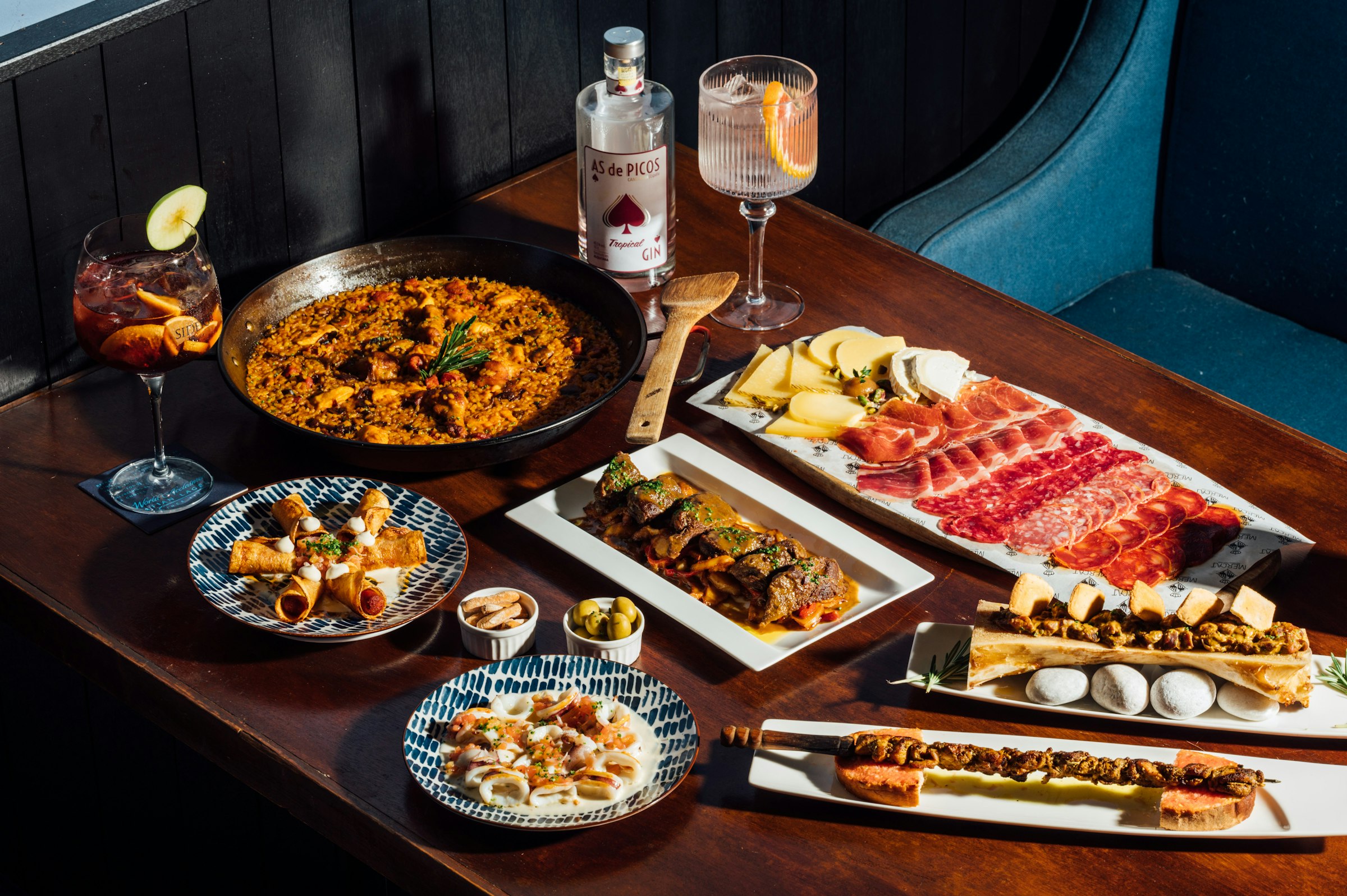
What is Mediterranean lager beer? It is the defining thirst of Barcelona — a pale, rice-bright lager poured in small, ice-cold glasses alongside jamón and olives, as foundational to Catalan street life as the Ramblas themselves. Lighter than a Pilsner, drier than most American lagers, and carrying just enough hop bitterness to cut through oil and salt, this style was born when Central European brewing expertise met Mediterranean sun and a culture that demanded refreshment above all else. To explore it is to map a largely uncharted corner of European beer history.
This expedition covers the geography, history, and sensory character of the Mediterranean lager — the Catalan and Spanish pale adjunct lager tradition that produced Estrella Damm and Moritz. For those who want to brew it at home, see How to Brew Mediterranean Lager at Home. For pairing it with food, see the Mediterranean Lager Food Pairing Guide.
The Geography: Barcelona and the Question of Beer in Wine Country
Barcelona is not where you would expect to find a thriving brewing tradition. Catalonia sits between France’s Languedoc and Spain’s Aragón — wine country on all sides, with a Mediterranean climate that runs warm from April through October and rarely dips cold enough to make traditional Central European lagering straightforward. And yet, by the second half of the nineteenth century, the city had established a brewing culture that would outlast most of its European contemporaries.
The geography of the region shaped the beer in direct ways. Summer temperatures in Barcelona regularly exceed 30°C (86°F), and the demand for cold, refreshing drinks in the months when no other cool beverage existed drove the style toward extreme lightness and crispness. German or Czech lager-drinkers, accustomed to malty, slightly fuller brews in cool cellar conditions, would find their usual beer an uncomfortable companion in the Barcelona heat. The Mediterranean lager is not simply a version of those styles — it is a response to a different climate, a different diet, and a different drinking occasion.
Catalonia also lacked the thick agricultural infrastructure of Central European brewing. Barley grew, but inconsistently. Rice, by contrast, was plentiful from the growing regions to the south, particularly around Valencia. That adjunct became not merely a cost-cutting measure but a flavor decision: rice ferments cleanly, leaves almost no residual sweetness, and produces a lighter body than an all-barley grist. The geography, in other words, wrote the recipe.
The History: Two Alsatians and a City That Needed Beer
The Mediterranean lager tradition begins, curiously enough, with immigrants from Alsace — the Franco-German border region that produced some of the nineteenth century’s most peripatetic brewing talent. Louis Moritz Trautmann, an Alsatian, founded Moritz in Barcelona in 1856, making it one of the oldest continually associated brewery names in Spain, though the brewery would close and reopen across its history. Two decades later, in 1876, August Kuentzmann Damm arrived in Barcelona from Alsace and established what would become Estrella Damm — the “Estrella” name being the flagship product brand, and “Damm” the brewer’s family name. Both men carried Central European lager-brewing knowledge with them: cold-fermentation techniques, the emphasis on lagering for clarity and clean flavor, and the Central European grain traditions.
What they found in Barcelona was a market largely untouched by industrial brewing. Local taverns served wine and spirits; cold, carbonated beer was a novelty. Damm and Moritz moved into that vacuum not by importing a style wholesale but by adapting: local adjuncts, local climate constraints, and the particular demands of a population that wanted something cooling to drink alongside the small plates that defined Catalan social eating. The beer that emerged was leaner than its Bohemian or Bavarian antecedents, more assertively dry, and served colder.
Estrella Damm grew through the early twentieth century to become Barcelona’s ubiquitous café beer. The caña, the small straight-sided tumbler of cold lager, became as standard to the Barcelona bar experience as the espresso. By mid-century, the brewery was one of Spain’s largest, and the Mediterranean lager had become invisible in the way that only truly embedded regional beers ever do: so present as to cease being noticed.
Moritz followed a more turbulent arc. The original brewery closed in the late 1970s under competitive pressure from larger national brands, and for nearly three decades the name existed only as a trademark. In 2004, the Moritz brand was relaunched by descendants of the founding family, and the company later opened a brewpub and production facility in Barcelona’s Sant Antoni neighborhood. That revival was part of a broader European craft beer awakening, but it was also a specifically Catalan cultural act — an assertion of Barcelona’s independent brewing identity at a moment when Catalan nationalism was finding renewed political expression.
The Spanish Civil War and the Franco decades of economic isolation shaped the broader industry considerably. International competition was blocked, domestic consolidation accelerated, and the major regional breweries came to dominate through scale. The Mediterranean lager survived precisely because it was local: it suited the climate, the food, and the culture in ways that imported styles never quite matched.
What is Mediterranean Lager Beer? Taste, Aroma, and Appearance
Appearance: Pale golden to straw yellow, with excellent clarity when properly cold-conditioned. Carbonation produces a white head of moderate persistence. The color sits lighter than most European lagers — the rice in the grain bill reduces both body and color — and the finished beer is notably brilliant, a quality prized in the region’s bar culture where the cold, clear glass signals freshness.
Aroma: Subtle and clean: a faint cereal grain note, light floral or grassy hop character, and very little ester or malt complexity. The nose is intentionally undemanding — this is a beer designed not to dominate the aromas of the food on the table alongside it.
Flavor: Dry, crisp, and lightly bitter. The rice adjunct creates a finish that is noticeably cleaner and drier than an all-barley lager — less residual sweetness, a more immediate fade. Hop bitterness sits at the low-to-moderate end, around 12–20 IBU in most commercial examples, just enough to provide structure without asserting itself over tapas. A gentle cereal character appears in the mid-palate, but the overall impression is of clean, refreshing dryness.
Mouthfeel: Light-bodied with lively carbonation. The rice lightens the body perceptibly compared to a German Pils or a corn-adjunct American lager — the texture is bright and almost effervescent. No cloying sweetness, no residual heaviness on the finish.
ABV: Typically 5.0–5.4%, enough to sustain a long tapas sitting without the session constraint of lighter styles.
The style’s closest BJCP 2021 approximation sits between Category 1B: American Lager and Category 5D: German Pils, but belongs fully to neither. It is drier than a standard 1B and carries more hop character than American Light Lager (1A), but is lighter-bodied and less aggressively hopped than a German Pils. Category 2A: International Pale Lager is probably the closest competitive fit, though the rice adjunct and Catalan provenance give it a regional specificity that generic “international lager” fails to capture.
The Ingredients That Make Mediterranean Lager Unique
Rice is the defining adjunct. While American adjunct lagers typically use corn to lighten body and reduce cost, the Catalan tradition chose rice — partly for regional availability, partly because rice ferments with exceptional cleanliness and produces a lighter, drier result. Flaked rice or pre-gelatinized rice is common in modern commercial production; historically, raw rice would have required a separate cereal mash step before addition to the main mash. The result is a beer with a slightly thinner body than a corn-adjunct lager and a finish that fades faster and more completely.
The barley base is typically lightly kilned Pilsner malt — the palest available, maximizing color lightness and preserving the grain’s fermentable sugars without adding caramel or toasty notes. Hop selection leans toward noble European varieties: Saaz, Hallertau Mittelfrüh, or similar, contributing floral and grassy notes without resinous or tropical character. The yeast is a clean-fermenting Central European lager strain that leaves no detectable ester signature when properly cold-fermented.
Commercial Examples Worth Seeking Out
- Estrella Damm (Barcelona, Spain): The archetype. Clean, dry, light straw color, and instantly identifiable as a product of its Mediterranean context. Widely exported and now available in many markets outside Spain — a reliable starting point for any comparison tasting.
- Moritz (Barcelona, Spain): The revived Moritz is slightly fuller than Estrella Damm, with a touch more malt character, reflecting its craft-era relaunch while staying true to the lean, dry Barcelona style. Harder to find internationally but worth seeking.
- Estrella de Levante (Murcia, Spain): A southeastern Spanish example, slightly lighter and milder than the Catalan versions. Represents the broader Iberian expression of the style beyond Catalonia.
- Alhambra Reserva 1925 (Granada, Spain): While slightly richer than the core Mediterranean lager profile, it demonstrates the quality ceiling the Spanish regional lager tradition can reach and is exported to markets across Europe and the Americas.
- San Miguel (originally Manila, Philippines; Spanish operations established separately): Now brewed under license across Europe, San Miguel’s Spanish variant shares the pale, dry character of the Mediterranean lager tradition, though its Philippine origins add a separate dimension to its story.
How Does Mediterranean Lager Compare to Similar Styles?
The Mediterranean lager is frequently grouped with American adjunct lagers or generic Euro lager — a misleading shorthand. American adjunct lagers (BJCP 1A/1B) typically use corn rather than rice, ferment at higher temperatures, and deliver a sweeter, rounder finish. The Mediterranean lager’s rice adjunct creates a drier, faster-fading finish, and its modest but present hop character distinguishes it from the blandest American examples.
Against German Pils (BJCP 5D), the Mediterranean lager is lighter in body, lower in bitterness, and less malt-assertive. German Pils examples range from 25 IBU (Bitburger) to 44 IBU (Jever) — well above the Mediterranean lager’s 12–20 IBU range. The Catalan style’s restraint in both hop and malt dimensions makes it a fundamentally different experience at the glass.
Perhaps the most illuminating comparison is with Japanese rice lagers such as Sapporo Premium or Kirin Lager, which use rice in similar proportions and achieve a comparable dry, clean finish. The geographic and cultural origins could hardly diverge more, but the brewing logic converges: rice, hot climate, refreshment-first design. That two brewing traditions on opposite ends of the Eurasian continent arrived at similar solutions through similar ingredients is one of beer history’s satisfying coincidences.
The Mediterranean lager rewards attention precisely because it seems, at first pour, designed to avoid it. Its genius lies in what it doesn’t do: no sweetness to clash with anchovies, no heavy body to overwhelm a hot afternoon, no assertive aroma to compete with garlic and olive oil. It is a beer shaped by its context as precisely as any Trappist ale or Bavarian Hefeweizen — it just happens to have been shaped by Barcelona’s sidewalk tables rather than a monastery’s scriptorium.
Ready to go deeper? – How to Brew Mediterranean Lager Beer at Home → – Mediterranean Lager Beer Food Pairing Guide →
Brew Cartographer explores the history, geography, and craft of rare and forgotten beer styles. Subscribe to our newsletter for new expeditions every week.