Rauchbier beer food pairing is, at its best, one of the most intuitive and satisfying exercises in the beer and food world — a beer so strongly defined by a single flavor principle that it makes the pairing logic almost self-evident. Bamberg’s ancient smoked lager, threaded with the aroma of beechwood, cured meat, and campfire, reaches toward the same territory as great barbecue, charcuterie, and roasted meats: the Maillard reaction, the alchemy of heat and smoke that transforms raw ingredients into something rich, savory, and complex. Few beer styles are as immediately useful at the dinner table as a well-made Rauchbier.
This guide covers the flavor principles behind Rauchbier pairings, the classic food matches, what to avoid, seasonal suggestions, and everything you need to know about serving the beer at its best. For the style’s history and character, visit What is Rauchbier Beer? →. If you want to brew your own batch, see How to Brew Rauchbier Beer at Home →.
The Flavor Principles Behind Rauchbier Pairing
Understanding why certain foods work with Rauchbier requires starting with what the beer actually brings to the table. Three flavor elements dominate and shape the pairing logic: smoke, malt sweetness, and clean lager bitterness.
The smoke in Rauchbier is phenolic and wood-derived — primarily from guaiacol and related compounds produced during beechwood kilning. This is chemically similar to the smoke compounds produced by burning hardwood in a barbecue or smoker. When you pair Rauchbier with smoked or grilled foods, you are exploiting what flavor scientists call a mirror pairing: matching like compounds in beer and food to create a sense of coherence and amplification. The smoked character in the beer doesn’t simply echo the food’s smoke — it deepens it, creating a layered effect where neither the beer nor the food dominates but both become more fully themselves.
The malt sweetness — fresh bread, caramel, a suggestion of toffee — does two things in a pairing context. Against rich, fatty foods (pork belly, aged cheese, terrines), it provides a counterpoint: sweetness cutting through fat in the same way that a glaze or a sweet mustard cuts through the richness of a roasted joint. Against foods with their own caramelized or toasted character (roasted root vegetables, grilled bread, onions cooked until sweet), it creates a bridge pairing: a shared flavor compound linking the beer and the food and producing a satisfying sense of completeness.
The bitterness — moderate, restrained, from Franconian noble hops — acts as a palate cleanser. Every sip of Rauchbier primes the palate to taste the food again cleanly. This is why Rauchbier works so well through a long, rich meal; the bitter finish prevents flavor fatigue and keeps the appetite engaged. The carbonation supports this: the CO₂ physically scrubs fat and oil from the palate, resetting it between bites.
What Rauchbier cannot do easily is work against very delicate flavors. The smoke is assertive; it will dominate anything subtle. Light white fish, fresh salad greens, delicate desserts — Rauchbier bulldozes these rather than complements them. Knowing this limit is as important as knowing the affinities.
Smoked and Cured Meats — The Classic Territory
This is Rauchbier’s home ground. The mirror pairing principle reaches its full expression here: smoked pork, beef brisket, cured sausages, and charcuterie all share flavor compounds with the beer, creating a pairing where the whole is unmistakably greater than its parts.
In Bamberg itself, the traditional pairing is Schäuferla — braised or roasted pork shoulder with crackling — served alongside a Seidla (half-liter) of Schlenkerla Märzen. The combination is not subtle: it is loud, satisfying, and entirely coherent. The smoke in the beer picks up the char on the crackling; the malt sweetness bridges the braising liquid; the bitterness cuts the fat. This is the pairing that Bamberg’s brewpub has served for centuries, and the logic has not changed.
Beyond the Franconian canon, barbecued brisket is one of the most compelling modern matches for Rauchbier. American-style low-and-slow brisket — rubbed with salt, pepper, and smoked over oak or hickory for 12+ hours — shares enough overlapping smoke compounds with Rauchbier that the pairing creates a feedback loop of smoked, savory richness. A cold Schlenkerla Märzen alongside a well-smoked slice of brisket is a combination that rewards attention.
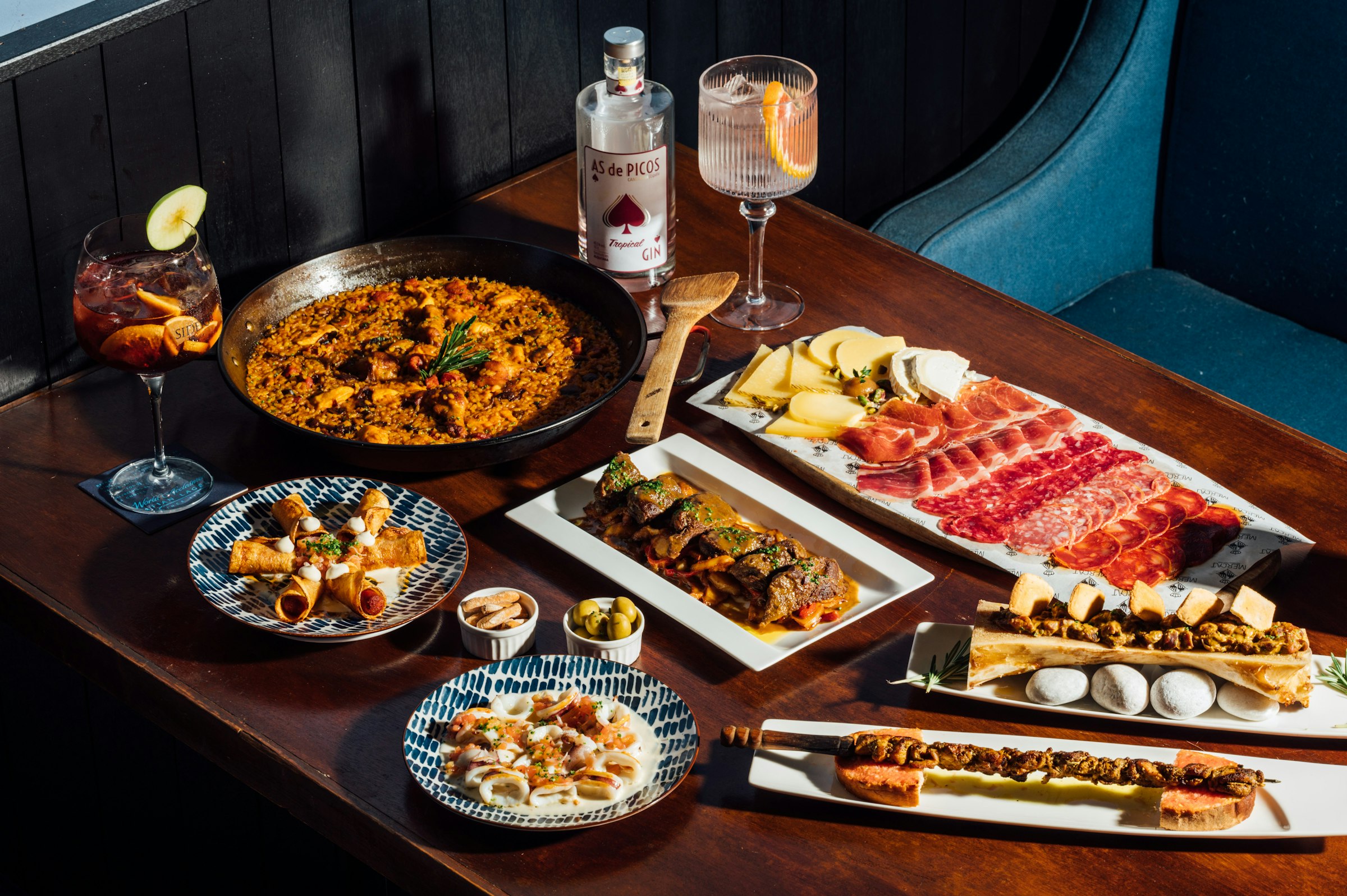
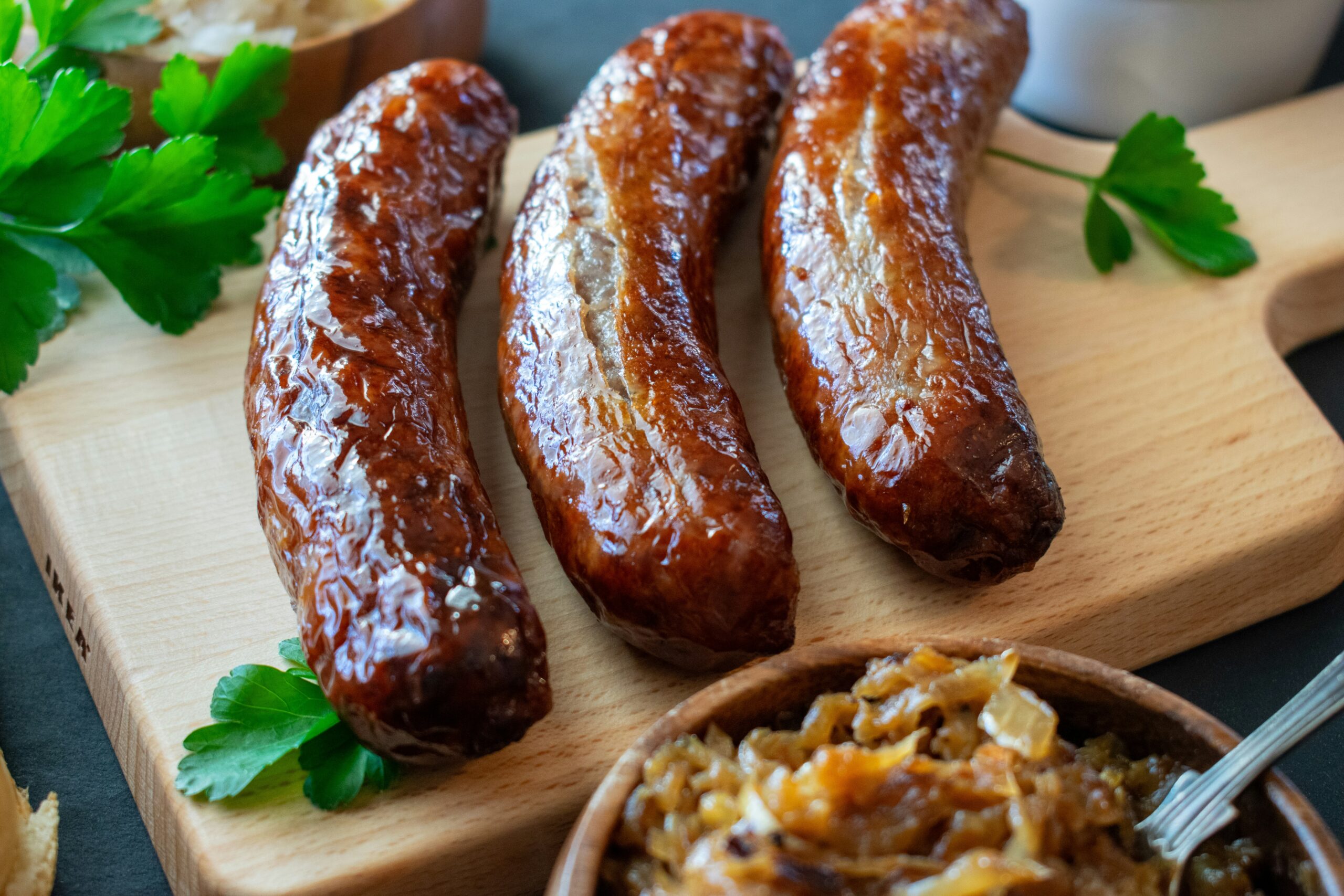
Smoked sausages of all kinds work: kielbasa, Franconian Bratwurst grilled over coals, merguez, andouille. The fat content of sausages is managed by the beer’s bitterness and carbonation; the smoke affinity does the rest. For home entertaining, a charcuterie board built around smoked sausages, cured ham, and aged smoked cheese is an ideal vehicle for introducing guests to Rauchbier — the food provides context for the beer’s assertive character, making it seem inevitable rather than challenging.
Broader Food Pairings
Aged and Smoked Cheeses: Rauchbier and cheese is underexplored territory compared to the meat pairings, but rewarding. Smoked Gouda, smoked Cheddar, and aged Gruyère all work through the mirror and bridge mechanisms. The nutty, caramelized notes in aged Gruyère find genuine common ground with Rauchbier’s toasted malt backbone. Smoked Gouda amplifies the beer’s own smoke in a way that is deeply satisfying alongside dark bread. Avoid fresh, mild cheeses (ricotta, burrata, young chèvre) — the smoke will overwhelm them entirely.
Roasted Root Vegetables: The caramelization and Maillard browning that develop on roasted carrots, parsnips, beets, and turnips create bridge points with Rauchbier’s malt sweetness and smoked character. A plate of roasted root vegetables — perhaps with thyme, olive oil, and a little honey glaze — makes a surprisingly effective vegetarian match for the beer. The sweetness of the vegetables anchors the smoke rather than fighting it.
Dark Bread and Rye: Pumpernickel, dark rye bread, and sourdough with significant crust char all find common ground with Rauchbier’s bread-and-smoke malt character. This is one of the style’s most accessible pairings — a straightforward meal of dark bread, smoked cheese, cured meat, and Rauchbier requires no cooking and makes the case for the style more clearly than almost any other combination.
Mushroom Dishes: The umami-rich, earthy quality of mushrooms (especially porcini, shiitake, and oyster mushrooms when roasted or sautéed) creates an interesting bridge with Rauchbier’s savory, almost meaty smoke character. A mushroom ragù on polenta, a wild mushroom risotto, or simply roasted mushrooms with thyme all work. The key is that the mushrooms should be cooked with sufficient heat to develop browning — raw or lightly cooked mushrooms are too delicate.
Grilled or Roasted Poultry: Chicken and duck roasted over a wood fire or charcoal grill are excellent partners for Rauchbier. The char on the skin provides the mirror; the fat in dark meat (particularly duck leg) provides the counterpoint for the beer’s bitterness to manage. Avoid white-meat chicken with no char — it’s too bland and will disappear behind the smoke.
What to Avoid
Delicate white fish: Sole, flounder, and lightly seasoned cod simply cannot hold their own against Rauchbier’s smoke. The beer doesn’t complement them — it erases them.
Very spicy food: The heat from chillies and Sichuan peppercorns amplifies bitterness in the beer, creating a harsh, unpleasant finish. High-spice cuisines that rely on fresh, bright flavors (Thai curries with citrus and herb notes, some Sichuan dishes) will clash with the smoke.
Light desserts and fruit-forward dishes: Fresh fruit tarts, lemon cakes, berry desserts — these require a foil that is either tart (sour beer, cider) or creamy (stout, milk stout). Rauchbier’s smoke intrudes on sweetness in an unpleasant way. A dark chocolate dessert with a hint of smoked sea salt can work as an exception; anything bright and fruity cannot.
Raw oysters and shellfish: Where Gose and Berliner Weisse find an excellent foil for oysters in their acidity, Rauchbier’s smoke character competes with the brine and minerality of raw shellfish in an unflattering way. Grilled or smoked oysters, however, are another matter entirely — see below.
Salads and light vegetable dishes: Rauchbier needs food with enough substance to anchor the smoke. A light green salad dressed with vinaigrette will be overwhelmed; the beer tastes harsh against fresh, acidic greens.
Rauchbier and German-Franconian Cuisine
No pairing section on Rauchbier would be complete without acknowledging the cuisine that evolved alongside it. Franconian cooking — the regional food of northern Bavaria — is built around pork, bread, and hearty preparation: slow-braised meats, potato dumplings (Klöße), dark bread, and a tradition of preserving food through smoking and curing that goes back centuries. This is not coincidence. The food and the beer grew up together, shaped by the same geography, the same forests, and the same practical need to produce flavor from simple ingredients.
The Schlenkerla brewpub in Bamberg serves a narrow but definitive menu: Schäuferla, sausages, dark bread, and occasional seasonal specials. These are not afterthoughts — they are studied companions to the beer, refined through generations of understanding what the smoked lager needs from its food. If you can visit Bamberg, eating at Schlenkerla is an experience that no amount of home pairing can fully replicate; the beer served directly from a wooden cask in a medieval dining room, with Schäuferla on the plate, is a specific and remarkable experience.
At home, Franconian cooking can be approximated: a slow-roasted pork shoulder rubbed with caraway, garlic, and coarse salt; sauerkraut braised with bacon and juniper; potato dumplings alongside a dark gravy. These dishes are built to stand up to Rauchbier’s intensity, and they deliver.
A Seasonal Perspective
Rauchbier is emphatically a cold-weather beer. The smoke character reads differently in summer — it can feel heavy and oppressive in hot weather, when the palate craves brightness and acidity. In autumn and winter, the same smoke reads as comforting and warming, a sensory reference to woodfires and sheltered spaces.
Autumn is peak Rauchbier season, and it is also when Schlenkerla releases its Urbock — the stronger, more intensely smoked seasonal version. Autumn pairings lean toward harvest food: braised game birds (pheasant, partridge), roasted root vegetables, venison stewed with dark beer and juniper, pumpkin soups with smoked paprika cream.
Winter pairings extend this logic: slow-braised beef short ribs, smoked ham hocks with white beans, cassoulet. The beer’s malt sweetness and smoke make it an ideal companion for the kind of long, slow cooking that cold weather invites.
Spring and summer are harder territory. If you want to serve Rauchbier outside these seasons, match it with a grill: smoked ribs, grilled sausages, brisket pulled from a smoker. The outdoor cooking context aligns with the beer’s character and makes the smoke feel at home rather than out of place.
How to Serve Rauchbier Beer
Serving temperature: Serve Rauchbier at 8–10°C (46–50°F) — slightly warmer than you would serve a typical lager. The smoke and malt complexity need warmth to fully express themselves; a Schlenkerla Märzen served at 3–4°C (37–39°F) will taste muted and flat. For food pairing specifically, erring toward 10°C (50°F) opens up the malt sweetness that makes the beer bridge to food.
Glassware: The traditional vessel for Rauchbier in Bamberg is the Seidla — a handled, dimpled half-liter mug with a textured exterior grip and a thick base. (The Masskrug is the larger 1-liter version, more associated with Oktoberfest tradition; in Bamberg, the 0.5-liter Seidla is the everyday drinking vessel.) Dimpled Bavarian beer mug (Seidla), 0.5L . The dimpled mug is not a romantic affectation; the handled vessel keeps the beer cooler as you drink by reducing heat transfer from your hand, and the thick glass insulates the contents. For those who prefer stemware, a Willi Becher — a slightly tapered, handle-free cylindrical glass standard across Franconian bars — is the modern everyday choice.
What to avoid: Avoid narrow tulip glasses and snifters for Rauchbier. These vessel shapes concentrate aroma too aggressively, amplifying the smoke to the point where it becomes unpleasant rather than inviting. Similarly, avoid highly thin-walled stemware that will warm the beer too quickly. Rauchbier does not need to be shown off the way a Belgian Tripel might — it needs to be drunk, comfortably, over a long evening.
Pouring: Pour Rauchbier with confidence — a steady, slightly angled pour that generates a moderate head of 1–2 cm (0.5–1 inch). The moderate carbonation of the style does not require a slow, cautious pour. Allow the head to settle before drinking; it integrates the aroma and softens the first impression of the smoke.
Rauchbier’s intensity is its greatest asset at the table: it has an opinion, and it expresses that opinion clearly. Match it with food that has been treated by fire — smoked, grilled, or roasted until brown — and the beer transforms from a curiosity into an essential companion. That directness is, in the end, what makes Bamberg’s oldest style one of the most food-friendly beers on the planet.
Explore more: – What is Rauchbier Beer? The Complete Style Guide → – How to Brew Rauchbier Beer at Home →
Brew Cartographer explores the history, geography, and craft of rare and forgotten beer styles. Subscribe to our newsletter for new expeditions every week.
Join The Dispatches — new expeditions, brew guides, and food pairings delivered when something worth reading goes live. No noise, no frequency targets. Sign up here →
Brew Cartographer explores the history, geography, and craft of rare and forgotten beer styles.